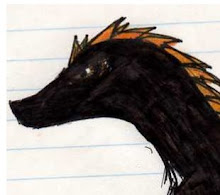
This marks the first entry of the subspecies of dragon, so here it is!
Sorgonic Dragons:
Sorgonic dragons are a branch of Dryskinic dragons. Making their home in the underwater city of Sorgon, Sorgonic dragons are built for deep sea living. Rather than having sharp back spines and head crests like the other species of dragon, Sorgonic dragons instead have slender tentacle like tendrils that protrude out of their backs and heads. Their tails, similar to Dryskinic tails, are not built as a weapon but rather a sort of fin to help better propel their bodies through water. Although their wings are stronger than any of the other species, they are not built for flying, but for swimming. An average Sorgonic dragon is able to keep its body aloft for just over two hours compared to the normal six to seven. Built at an average of ten to eleven feet tall, and 360 to 390 pounds, Sorgonic dragon's slender and elongated bodies help to better them in their swimming. Able to project water, wind, pulse waves, hypnosis, paralysis, and confusion, Sorgonic dragons are the most limited in their attack patterns. Usually green, blue, purple, white, teal, yellow, or maroon in color, Sorgonic dragons are among the most rare species to actually see while visiting Tarterrior. Known Sorgonic dragons of importance include:
Malamax Yevyir
Let me know if you have questions. Thanks!
Showing posts with label Dryskinic. Show all posts
Showing posts with label Dryskinic. Show all posts
Wednesday, May 6, 2009

Thursday, April 30, 2009
Species Of Dragon #1 (Dryskinic)
So here is my first post on the different types of dragon species.
Dryskinic Dragons:
The Dryskinic dragon is one of the two most common types of dragon species found in Tarterrior. Boasting one pair of wings, curved claws, jagged teeth, a long tail, and a row of spikes across its back, the Dryskinic dragon's closest relative is the Phoenical dragon. Dryskinic dragons are often bland in color--ranging from one to three different hues at the most. They bear no colorful tattoos or intricate markings along their body, and they often have a white stomach to help blend into the sky to those below while flying. Dryskinic dragons tend to have a rounded off snout, unlike their Phoenical cousins whose snout and face are sharp and pointed. Dryskinic dragons are plain in appearance, having no more than one set of teeth and back spines. Their tails, unlike other species, are used to help aid them in flying, swimming, and running, rather than attacking and defending. The second oldest species of dragon, Dryskinic dragons are knowledgeable in methods of using their surrounding terrain, as well as finding a perfect defensive resting spot for a home. Because of their simple nature, Dryskinic dragons do not possess any extreme methods of attack and are thus limited to such forms of energy as: fire, pulse waves, heat waves, paralysis needles, and hypnotic abilities. Dryskinic dragons also tend to be somewhat taller in height, while remaining lean, ranging from ten to eleven feet and weighing between 380 to 400 pounds. Some Dryskinic dragons of significant importance include:
Greilner Drudlok
Wapper
Lord Handonna Conquet
If you have any comments or questions on this particular species of dragon, please let me know. Thanks!
Dryskinic Dragons:
The Dryskinic dragon is one of the two most common types of dragon species found in Tarterrior. Boasting one pair of wings, curved claws, jagged teeth, a long tail, and a row of spikes across its back, the Dryskinic dragon's closest relative is the Phoenical dragon. Dryskinic dragons are often bland in color--ranging from one to three different hues at the most. They bear no colorful tattoos or intricate markings along their body, and they often have a white stomach to help blend into the sky to those below while flying. Dryskinic dragons tend to have a rounded off snout, unlike their Phoenical cousins whose snout and face are sharp and pointed. Dryskinic dragons are plain in appearance, having no more than one set of teeth and back spines. Their tails, unlike other species, are used to help aid them in flying, swimming, and running, rather than attacking and defending. The second oldest species of dragon, Dryskinic dragons are knowledgeable in methods of using their surrounding terrain, as well as finding a perfect defensive resting spot for a home. Because of their simple nature, Dryskinic dragons do not possess any extreme methods of attack and are thus limited to such forms of energy as: fire, pulse waves, heat waves, paralysis needles, and hypnotic abilities. Dryskinic dragons also tend to be somewhat taller in height, while remaining lean, ranging from ten to eleven feet and weighing between 380 to 400 pounds. Some Dryskinic dragons of significant importance include:
Greilner Drudlok
Wapper
Lord Handonna Conquet
If you have any comments or questions on this particular species of dragon, please let me know. Thanks!
Subscribe to:
Posts (Atom)